Bailey’s three-stage lateral raise moves from banded dumbbell reps to failure and banded pulses, extending tension as the side delts fatigue.
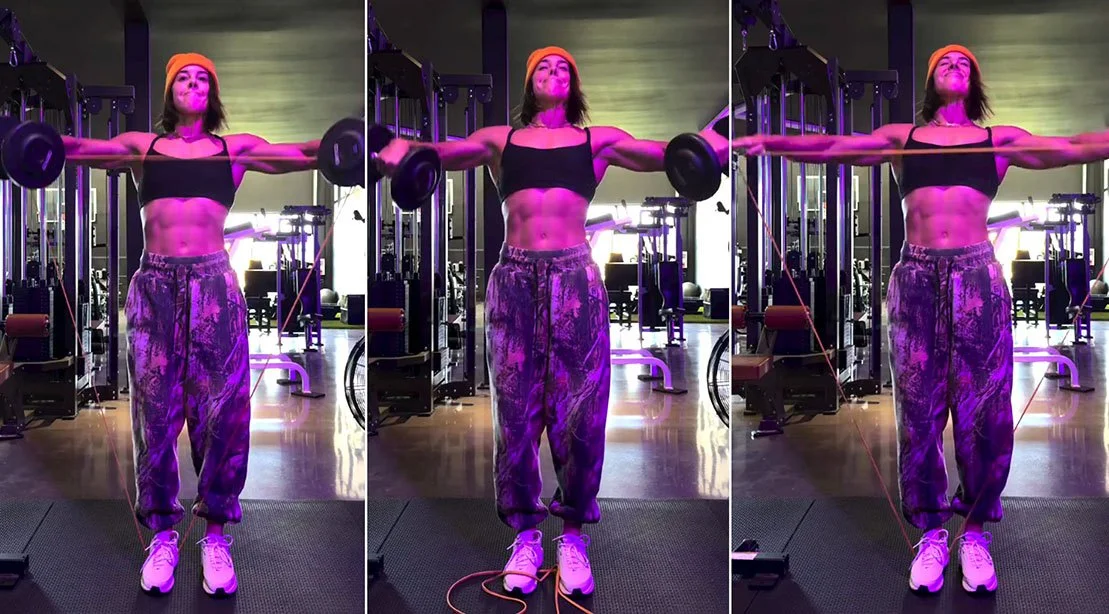
Dana Linn Bailey’s lateral raise extended set turns one shoulder exercise into three back-to-back stages, keeping the side delts working as fatigue builds. The 2013 Olympia Women’s Physique winner shared the sequence on Instagram, pairing a resistance band with dumbbells before finishing with short-range pulses. The structure is straightforward: begin with both sources of resistance, remove the band for a set of full-range raises, then return to the band for partial reps. That order makes the set more demanding as it goes, without requiring a complicated exercise change or a long list of equipment.
The three-stage set
- Banded dumbbell lateral raises: 10 reps
- Dumbbell lateral raises: Continue to failure
- Banded lateral raises: Quarter-rep pulses to failure
The sequence uses a familiar shoulder isolation movement, but changes the resistance and range of motion as the set progresses. The first stage has a fixed target of 10 repetitions; the next two are guided by fatigue rather than a predetermined count. That distinction matters in practice: the set’s total workload can vary with the dumbbell weight, the band, and how strictly each repetition is performed.
How Bailey runs the sequence
Choose dumbbells heavy enough to make the first 10 banded reps challenging. The band adds resistance on the way up and on the lowering phase, Bailey explained to her Instagram followers. Control the descent instead of letting the band pull your arms down. That cue gives the lowering portion a deliberate role in the set rather than treating it as a reset between repetitions. It also makes the band’s pull something to manage throughout the movement, not just an extra challenge as the weights rise.
Then remove the band and keep the same dumbbell weight, continuing the lateral raises until you can’t complete another rep. For the final stage, set the dumbbells aside and return to the band for quarter-range pulses until failure. The transitions are part of the method: there’s no long recovery interval described between stages, so fatigue carries from one version of the raise into the next. If you're working this into a shoulder session, the practical question is whether you can move safely and consistently once that fatigue sets in.
Bailey says the pulses can feel manageable at first, but the burn builds quickly. When it does, pause for five to 10 seconds, then continue. She typically gets 20 to 30 reps in this stage and favors the lightest band. That count is a report of her own performance, not a target every lifter needs to match; band tension and individual capacity affect how quickly the pulses become difficult.
Why the final pulses matter
The format extends the set past the point where full-range dumbbell reps stop, while the pulses keep the shoulders under tension near the top of the movement. Bailey describes that uninterrupted tension at peak contraction as the point of the short-range finish. Her practical cue is simple: keep moving through the burn, using a brief pause when needed. The short range changes the task: instead of lifting through the full arc, the lifter repeats a small portion of the movement after the larger raises have become difficult.
That’s the logic behind the sequence, though it doesn’t make the method automatically suitable for every lifter or every session. “Failure” can mean different things in the gym: a rep that can’t be completed with control is a different stopping point from one that can’t be completed at all. Here, the useful detail is Bailey’s emphasis on controlled lowering and brief pauses, rather than treating discomfort alone as a reason to rush through the repetitions.
What the sequence offers—and what to watch
For Bailey, the appeal is a longer, more demanding finish to a familiar isolation exercise. The sequence’s defining feature is its progression: band and dumbbells, dumbbells alone, then banded pulses to close. This is more significant than it looks as a piece of workout design: the challenge comes from changing the resistance setup and the rep range within one extended set, rather than simply adding another exercise.
And yet, the method’s simplicity can make it easy to overdo. A set that runs through two failure stages can be taxing, and the source doesn’t provide a broader weekly program or guidance on how often to repeat it. The sensible takeaway is narrower: it’s one option for adding a hard finisher to shoulder training, with the band and dumbbell load chosen so that the movement stays controlled. A brief pause. Then the last reps.
If you're considering the sequence, pay attention to whether your form changes as you tire and whether the band lets you control both directions of the movement. The goal Bailey describes is sustained work near the top of the raise, but the reported rep counts and “burn” are individual details, not evidence that one setup will suit everyone. That said, the format is easy to understand and adaptable in one obvious way: the band’s resistance and dumbbell weight determine how demanding the stages feel.
Follow Dana Linn Bailey on Instagram: visit her profile.



Discussion
Sign in to join the discussion.