Research finds similar muscle growth from machines and free weights. Newer machines add stability and adjustability, while free weights build lift specific strength and coordination.
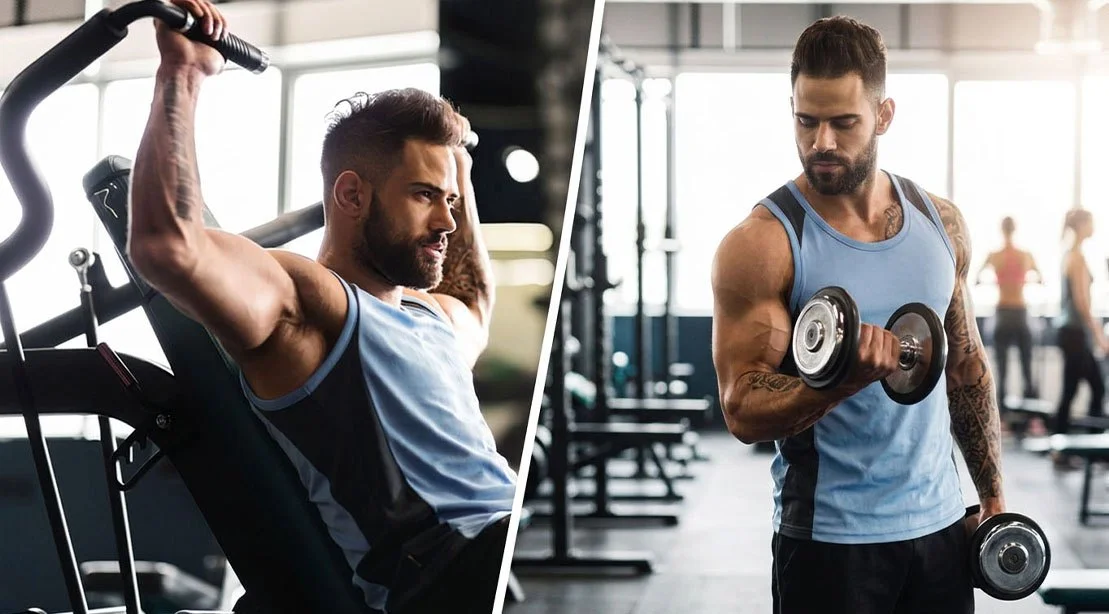
For muscle growth, the barbell no longer has a clear scientific edge over machines. Current research finds broadly similar results from both, while newer machines offer more control over resistance, setup, and stability. The practical choice depends on what a lifter is training for: a machine can make it easier to load a target muscle, but it won’t teach the same skills as a barbell lift.
Machines have changed the trade-offs
Modern equipment from Arsenal Strength, Rogers Athletic’s Pendulum Strength line, and Prime Fitness goes well beyond the fixed-path machines many lifters associate with beginner training. Adjustable seats, pads, handles, starting positions, and ranges of motion can help people find a comfortable setup. Some presses use converging arms, bringing the hands closer together near lockout; some rows allow the arms to diverge or move independently.
Resistance profiles have also become more adjustable. Cams, lever arms, and different loading positions can change where an exercise feels hardest. Prime Fitness, for example, offers machines with multiple loading positions intended to emphasize different portions of a movement. That may matter because a muscle’s ability to produce force changes with joint angle.
The other advantage is stability. A guided path asks less of the lifter’s balance and positioning, which can make it easier to direct effort toward the muscle being trained. “If I’m trying to maximize mechanical tension through a particular muscle,” says Gareth Sapstead, CSCS, “reducing the stability demands can be a good thing because you’re challenging the target muscle rather than worrying about balance, coordination, or maintaining position.”
Independent arms add another option: each side can work separately while the machine still provides support and a guided path. That makes unilateral training easier to set up and can help expose side-to-side differences.
Jay Ashman of Ashman Strength sees this equipment boom as part of an “optimization” trend, with a strong focus on aesthetics. The easiest tool for a given exercise may be efficient, he says, but that doesn’t automatically make it the best tool for every goal.
Muscle growth and strength tell different stories
The research so far doesn’t establish a muscle-building winner. A 2023 systematic review and meta-analysis covering 13 studies and 1,016 participants found no meaningful advantage for machines or free weights in the five studies that measured hypertrophy. A separate review by Heidel and colleagues reached a similar conclusion, as did a 2023 study comparing machine-based and free-weight training.
There’s a key limitation: these studies compare broad categories of equipment. They don’t settle whether the newest machines, with adjustable resistance profiles and more flexible setups, produce better results than older designs or free weights.
Strength gains are more specific to the equipment used in training. The 2023 meta-analysis found that people tended to improve more on the type of equipment they practiced with: free-weight trainees did better on free-weight tests, while machine trainees did better on machine tests. A Pendulum squat can train the quads and glutes, but it doesn’t reproduce the balance, coordination, or barbell technique involved in a back squat.
For hypertrophy, that distinction leaves room to choose the exercise that lets someone train a muscle through a useful range and progress consistently. For a particular lift or strength test, the equipment itself is part of the skill.
A Pendulum squat and a barbell squat solve different problems
The Pendulum squat follows a guided arc and reduces the need to balance a bar or manage as much torso control. Depending on the machine and the lifter’s setup, it may make it easier to reach depth and focus on driving through the legs. Some versions also change how resistance feels at different points in the movement.
That support can suit lifters whose mobility or comfort makes a barbell squat difficult. It can also let someone challenge the quads without balance or bar position becoming the limiting factor. But the machine doesn’t guarantee more quad growth, and it won’t build the same barbell-specific skill.
The back squat remains useful for developing strength and coordination under a barbell. It’s also necessary for powerlifters who compete in the lift. For someone focused on total-body strength, barbell proficiency, or a squat performance goal, a Pendulum machine is a complement rather than a substitute.
Free weights still earn their place
Barbells and dumbbells remain versatile ways to train. Barbells are easy to load progressively, and dumbbells typically come in small weight increments. Barbells also allow heavier loading than dumbbells in many exercises because they’re more stable to handle.
Free weights leave the movement path in the lifter’s hands. Grip, stance, elbow position, and range of motion can change without switching equipment, which helps people adapt an exercise to their body and preferences. That freedom comes with a demand: the lifter has to control the load and coordinate the movement.
Matt Wenning of Wenning Strength argues that free weights should remain a foundation because they develop strength, coordination, and stability that machines don’t fully reproduce. Sapstead likewise favors them for positional control and producing force through more complex patterns, particularly for people who want their physique to perform as well as it looks.
Premium plate-loaded machines can cost more, take up more room, and serve a narrower purpose. A set of free weights can support many exercises with changes to stance, grip, or body position. That difference matters when access, space, or equipment variety is limited.
Use machines to manage effort and fatigue
Machines can make hard sets easier to manage. A chest press or leg extension taken close to failure doesn’t require the same balance and load control as a heavy barbell bench press or squat. That can be useful when a spotter isn’t available, or when the aim is to push a target muscle without the demands of a more complex lift.
Wenning sees machines as a way to build muscle, address weaknesses, and add training volume without the same level of systemic fatigue associated with some free-weight exercises. That doesn’t mean machines eliminate fatigue. It means exercise selection can distribute the demands of a session across movements with different stability and positioning requirements.
For lifters whose main goal is a bigger squat, deadlift, or bench press, practicing those barbell lifts still matters. Wenning’s view is that machines should support free-weight training for those goals. For muscle growth, the choice is more flexible: a machine may be the better fit if it offers a comfortable setup, a useful range of motion, and a way to progress.
Example sessions combining both
The following sessions pair free-weight lifts with supported machine work. The rep ranges and set counts provide a starting structure, with exercise selection reflecting the different demands of each tool.
| Upper-body exercise | Sets | Reps |
| Barbell bench press | 4 | 6–12 |
| Chest-supported machine row | 4 | 10–15 |
| Converging machine chest press | 3 | 10–15 |
| Meadows row | 3 | 8–12 per side |
| Cable lateral raise | 3 | 12–15 |
| Lower-body exercise | Sets | Reps |
| Barbell Romanian deadlift | 4 | 6–12 |
| Pendulum squat | 4 | 6–12 |
| Dumbbell split squat | 3 | 8–12 per leg |
| Hip thrust machine | 3 | 10–15 |
| Seated leg curl | 3 | 12–15 |
Choose the tool that fits the goal
Today’s machines have earned a place alongside barbells and dumbbells. They offer more ways to adjust resistance and body position, and their stability can help lifters focus on a target muscle or train hard with less concern about controlling a free load. Yet the evidence available doesn’t show that modern machines build more muscle than free weights.
As Sapstead puts it, the best exercise is the one that places sufficient tension on the intended muscles through a useful range of motion and allows consistent progression. That may call for a barbell, a dumbbell, or a well-designed machine. The clearest approach is to match the tool to the job: practice specific lifts with the equipment those lifts require, and use machines where their support and setup help you train effectively.



Discussion
Sign in to join the discussion.