Stephanie Sanzo’s five-exercise routine combines hip thrusts, split squats and high-rep Romanian deadlifts for a focused glute session.
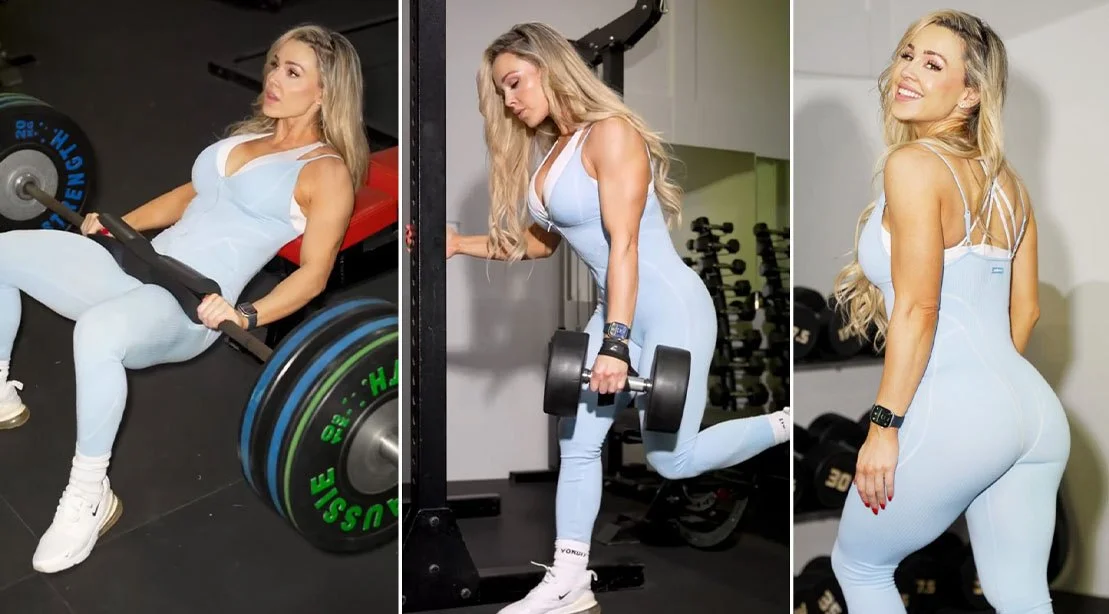
Stephanie Sanzo’s routine builds its glute focus through two hip thrust variations, a supported unilateral squat, hip abduction work and a high-rep Romanian deadlift finisher. The Australian weightlifter and personal trainer shared the session with her 3.3 million Instagram followers. Its five movements form a clear template for a demanding lower-body workout, though the exercise list alone doesn’t show the loads, rest periods or effort level Sanzo used.
The five-exercise session
- Standing hip thrust machine: 3 sets of 20, 15 and 10 reps
- Barbell hip thrust: 3 sets of 10 reps
- Rack-supported dumbbell Bulgarian split squat: 3 sets of 12 reps
- Hip abduction machine: 3 sets of 15 reps
- Bench-supported single-leg dumbbell Romanian deadlift: 3 sets of 20 reps
The order gives the glutes several kinds of work: hip extension, single-leg strength, outward movement at the hip, and a final hinge pattern. That variety matters because a session built around one lift can leave other movement demands untouched. Here, the two thrusts lead, while the split squat and Romanian deadlift ask each side to contribute more independently.
The Instagram post drew followers who praised Sanzo’s strength and physique. One commenter wrote, “Steph proving that muscles don’t take away from femininity.” The response points to the visibility of strength training in fitness culture, where muscularity is still sometimes treated as incompatible with conventional ideas of femininity.
Why the sequence works
The session opens with standing hip thrusts, using a descending rep pattern of 20, 15 and 10 across three sets. That structure starts with a higher-repetition set and reduces the target as the exercise progresses, but the post doesn’t specify how Sanzo adjusts the weight. Her approach is built around progressive overload: challenging the muscles so they adapt over time. The principle depends on tracking effort and gradually increasing the demand, rather than repeating the same session unchanged.
If your gym lacks a standing hip thrust machine, Sanzo suggests cable pull-throughs as a substitute. The equipment differs, so the movements won’t feel identical; both can be used to train a hip extension pattern, with the cable offering a practical option when the machine isn’t available. That’s useful flexibility in a routine that otherwise relies on several pieces of gym equipment.
Barbell hip thrusts follow, placing the glutes at the center of the lift. Sanzo uses a bench to support her upper body and drives her hips to full extension at the top. Pairing this with the standing version gives the session two consecutive hip thrust patterns, a concentrated dose of the same broad movement. This is more significant than it looks: the sequencing places a substantial amount of glute-focused work early, when fatigue is likely lower than it will be later in the workout.
A similar setup and technique are covered in this guide to hip thrust form. Technique matters because a prescribed rep count only describes how many repetitions to perform; it doesn’t tell you whether each rep is controlled or whether the load is appropriate. Here's the thing: a routine is a framework, not a complete coaching plan.
Next, the rack-supported Bulgarian split squat adds a single-leg challenge. Holding the rack for balance reduces the demand on the upper body, while dumbbells increase the load on the working lower body. The combination puts the glutes and hamstrings to work without making balance the main test. For someone who finds unsupported split squats awkward, that support can make it easier to focus on the working leg and maintain a consistent movement.
The hip abduction machine shifts attention to the outer hips. It trains the abductors, including the gluteus medius, and provides resistance that's harder to replicate with free weights. Those muscles also contribute to pelvic stability and help round out the outer hip. And this is the part most people overlook: a machine exercise can complement the larger lifts without replacing them. See this hip abduction machine overview for more on the movement.
Sanzo finishes with bench-supported single-leg dumbbell Romanian deadlifts, prescribing 20 reps for each of three sets. The hip hinge makes the glutes and hamstrings do the work, while the bench offers support during the single-leg movement. At that point in the session, the high rep target adds a demanding finish; keeping the hinge controlled is more useful than chasing the number at the expense of form. A finisher. But one that still needs sound execution.
What the routine can—and can’t—tell you
Taken together, the routine moves from hip extension to unilateral strength, then ends with a high-rep hinge—an efficient structure for a focused glute session. It also shows how support can be used strategically: the rack and bench reduce balance demands during single-leg work, leaving more attention for the target movement. If you're working in this space, the transferable idea is the mix of movement patterns and the use of support to make challenging exercises more manageable.
That said, the post gives readers a session outline rather than a full prescription. It lists sets and reps, but doesn’t provide loads, rest times, warm-up details or how often Sanzo repeats the workout. Those choices affect how demanding a session becomes and how it fits into someone’s wider training. The numbers here are underwhelming as a standalone guide to progression; the value lies in the structure, while the individual training decisions remain out of view.
Follow Stephanie Sanzo on Instagram.



Discussion
Sign in to join the discussion.