IFBB Pro Tanya Johansen recommends Spanish squats for quad-focused training, with setup cues and ways to increase time under tension.
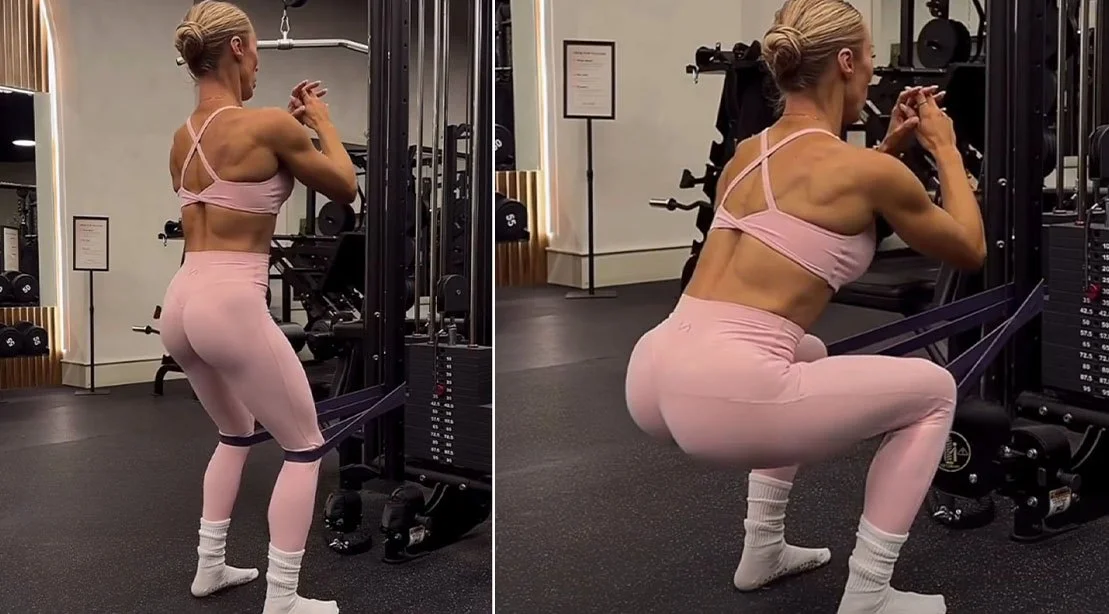
The Spanish squat gives lifters a way to work the quadriceps without resting a heavy barbell across their shoulders. IFBB Pro and physique coach Tanya Johansen recommends it particularly for people over 40 and for those who find barbell squats uncomfortable. The movement uses a resistance band behind the knees for support, allowing the lifter to sit back while keeping the torso upright and the knees moving forward.
“It fries your quads… when done correctly,” Johansen says. That qualification matters: the band changes how the squat is supported, but it doesn't remove the need to control the movement or find a position that feels manageable. Spanish squats are also used in knee rehabilitation, though that doesn't make every variation suitable for every person or every stage of recovery.
Set up with a resistance band
Anchor a resistance band to a cable station or power rack, then place it behind your knees. You can stand inside one loop or position a separate loop behind each knee, as shown in Johansen’s demonstration. The anchor needs to stay fixed while you move, and the band should provide support as you lean back into it.
Step back until the band is taut, then sit back into its support as you squat. Keep your torso tall and let your knees travel forward; Johansen’s cues are direct: “Band behind your knees, sit back into it, stay tall, let your knees come forward.” Control both the descent and the rise so the band doesn't turn the repetition into a bounce. The point is to make the quads work through the movement, not simply to reach a position.
Why it can suit quad-focused training
The band helps support an upright position, while the exercise places substantial demand on the quads without a barbell loading the shoulders and back. That makes the Spanish squat a useful option when the goal is to train the front of the thighs while limiting the demands of a bar across the upper body. It doesn't establish that the movement is universally easier on the knees; the band-supported setup still asks the knees to bend under effort.
Johansen argues that muscle effort matters more than chasing heavy weight: “You don’t need a heavy bar on your back to grow your legs. Forget heavy. Make the muscle do the work.” This is more significant than it looks: a training choice doesn't need to be measured by the load on the bar if the target muscle is doing the intended work. And yet, removing the barbell alone doesn't guarantee a productive set; position, control, and effort still shape the exercise.
That approach may appeal to lifters seeking a knee-focused exercise or a lower-load option. If you're working around discomfort, the practical question is whether this particular movement feels tolerable and controlled for you. Johansen also cautions against treating the weight on the bar as a measure of progress: “You’re not in there to impress anyone. You’re in there to make sure your quads earn it.” A hard set can be the aim. A strained, uncontrolled one isn't.
Progress the movement with tempo
To make Spanish squats harder, pause in an isometric hold at the top before lowering, or slow the descent to extend time under tension. Those changes increase the challenge without requiring a heavier bar, though they also make pacing and consistency more demanding. Start with a range you can control, then use tempo to make the same movement more demanding.
Johansen suggests three sets of eight to 12 reps. Treat that as a starting prescription rather than proof that one rep range suits everyone; the useful measure is whether you can maintain the position and finish the repetitions with deliberate control. Here's the thing: progress can come from making each rep more demanding, not just adding external load. “It’s not the weight. It’s the work.”
What the exercise can—and can't—tell you
The Spanish squat offers a distinct way to load the quadriceps, and the band gives the lifter a clear support point to sit against. For someone who dislikes a barbell squat or wants a lower-load variation, that can make it a practical addition to training. The setup doesn't replace sound technique or turn a rehabilitation exercise into a universal solution. A useful option. Not a guarantee.
For lifters over 40, Johansen's recommendation reflects the value of having alternatives when a familiar lift feels uncomfortable. That said, the source provides her coaching perspective, not evidence that Spanish squats outperform other quad exercises or prevent injury. The case is narrower and more practical: the movement can challenge the quads without loading the shoulders with a heavy bar, provided the lifter can perform it comfortably and with control.
Follow Tanya Johansen on Instagram.


Discussion
Sign in to join the discussion.