Andreas Almgren won the men’s race on his marathon debut, while Sheila Chepkirui reclaimed the women’s title in a close New York finish.
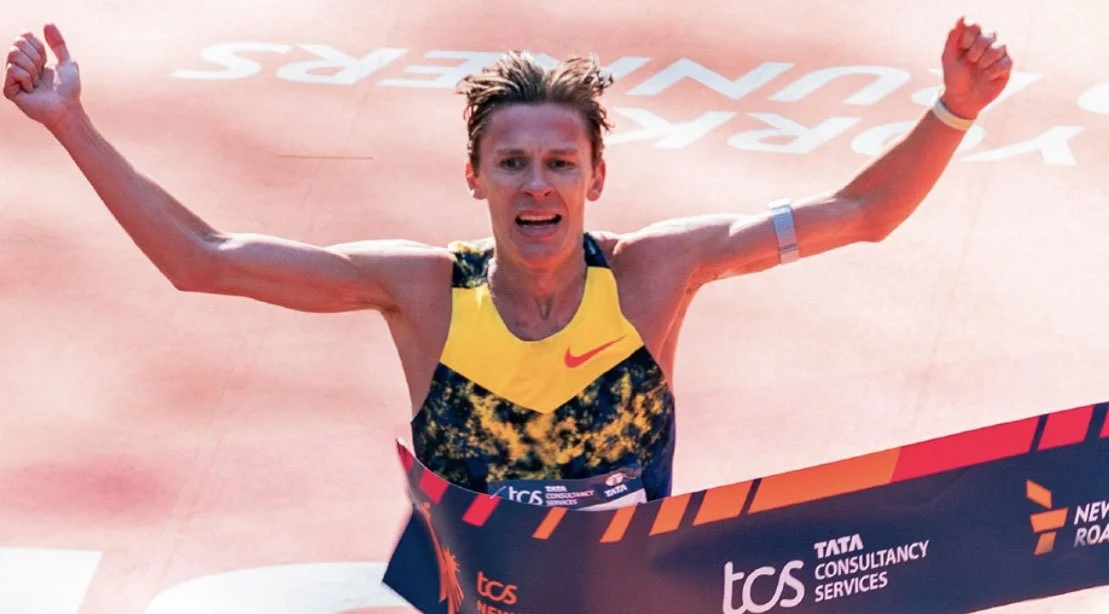
The 2026 New York City Marathon put sharply different tests of endurance on the same course: a world-class runner’s first 26.2 miles, a sprint finish in the women’s race, and an 80-year-old’s first marathon. Nearly 60,000 people ran through the five boroughs on Nov. 1, from title contenders to costumed participants and first-time finishers, with crowds lining the route. That range is part of what makes the race unusually legible as a sporting event: the elite competition is measured in seconds, while many participants are chasing a personal milestone measured in years of preparation. The course links those efforts without making them equivalent. Each runner faces the same broad route, but the stakes, pace and meaning of finishing differ sharply.
Almgren turns a debut into a win
Sweden’s Andreas Almgren won the men’s race in 2:06:01, a striking first marathon for the reigning world half-marathon champion and European 10,000-meter champion. His résumé was already exceptional at shorter distances; New York was his first test over 26.2 miles. That distinction matters because success on the track or over the half-marathon distance doesn’t automatically settle how an athlete will handle the marathon. The longer race introduces a different problem: holding a demanding pace while managing the physical and tactical costs that accumulate over hours.
The leaders stayed together deep into the race. Almgren made his move in the final mile, finishing 13 seconds ahead of Italy’s Yemaneberhan Crippa. Lesotho’s Kamohelo Mofolo took third, while defending champion Benson Kipruto finished fourth. A late separation can look simple in the results, but it leaves little room for error: the contenders had to remain close enough to contest the finish, then respond when the decisive move came. Almgren’s victory also puts a clear result beside the uncertainty that usually surrounds a debut at this distance.
A debut at this level reflects years of elite running, not a shortcut around marathon preparation. The distance asks athletes to manage pace and fueling while sustaining effort as fatigue builds. New York adds bridges, hills, turns and uneven pavement to that equation. The route’s changes can complicate rhythm, and runners must keep making decisions as their bodies tire. This is more significant than it looks: Almgren didn’t simply bring speed from shorter events; he converted it into a winning performance across a course that demands patience as well as pace.
A close finish in the women’s race
Kenya’s Sheila Chepkirui reclaimed the title she won in 2024, crossing the line in 2:24:36. American Jess McClain surged past defending champion Hellen Obiri in the closing meters to take second in 2:24:42. Obiri finished one second later in third, and McClain became the first American woman on the New York podium since 2018. The six seconds separating first and second, followed by a one-second gap to third, make this a result defined by a narrow finish rather than a runaway victory.
That compressed margin gives the closing stretch particular weight. McClain’s pass changed the order at the front, while Chepkirui held on to the lead and the title. For spectators, a finish like this makes the outcome immediately clear; for the athletes, it reflects a race in which positioning and the ability to respond late can matter as much as the earlier pace. And yet the result also resists a tidy story about one decisive burst. Chepkirui’s win, McClain’s advance and Obiri’s near miss are separate achievements, all decided within moments.
Wheelchair racing and a first marathon at 80
Switzerland’s Marcel Hug secured his eighth New York title in the men’s wheelchair race, finishing in 1:28:14 and beating American Daniel Romanchuk by one second. Swiss racer Catherine Debrunner won the women’s event in 1:40:02, nearly eight and a half minutes ahead of Tatyana McFadden. The results reflect the distinct demands of wheelchair racing, where upper-body power, equipment control and race tactics shape performance. The one-second men’s margin points to how closely the leaders were matched at the finish, while Debrunner’s winning gap tells a different story about the women’s race.
These competitions belong alongside the running events, but they shouldn’t be treated as the same test with a different finishing time. Wheelchair racers manage speed and control through the course using different physical skills and equipment. Turns and changing terrain can call for careful handling as well as strength. (And this is the part most people overlook.) A marathon’s format can include distinct forms of racing, each with its own tactical demands, even as all of them share the same public route and day.
Another milestone belonged to Bronx resident Mildred Baker. She took up running in her late seventies and completed her first marathon at 80, finishing in 7:03:49. Her effort and the elite races at the front show how one event can hold very different ambitions and measures of achievement. Baker’s result isn’t a footnote to the competition at the front; it gives the day another scale, one in which completing the distance is the achievement. A first marathon at 80. That’s a striking measure of persistence.
One course, many definitions of performance
Almgren’s win, McClain’s late charge and Baker’s finish each mark a different kind of accomplishment. The marathon’s appeal lies partly in that range: the same demanding route can host a contest decided by seconds and a personal challenge that takes hours. New York’s results make the point plainly—endurance has more than one measure. For the elite runners, the standings separate competitors who may have spent much of the race together. For participants like Baker, the finish records a personal first that can’t be reduced to placement.
What the results say about the marathon
If you’re working in this space, the event offers a useful reminder that a large road race serves several audiences at once. It’s a championship contest for the leaders, a showcase for wheelchair racers, and a personal undertaking for the thousands who run at their own pace. Those roles can coexist, though they invite different ways of judging success. The winning time and the final sprint are easy to headline; the breadth of the field explains why the same race matters to people far beyond the podium.
That said, the shared course doesn’t erase the differences in preparation or performance. Almgren’s debut win is a test of how his shorter-distance credentials translated to the marathon; McClain’s podium finish turns on a late pass; Hug’s title and Debrunner’s victory belong to wheelchair racing; Baker’s first finish at 80 measures a personal undertaking. What this means for you as a reader is that a single set of results can tell several stories, but only if the coverage leaves room for more than the winner’s time. The day’s clearest lesson is simple: endurance can be judged by speed, position, persistence or the act of reaching the finish at all.



Discussion
Sign in to join the discussion.