For Dougal MacKenzie, Sam Retford built practical strength with weighted hill hikes, agility work and time outdoors.
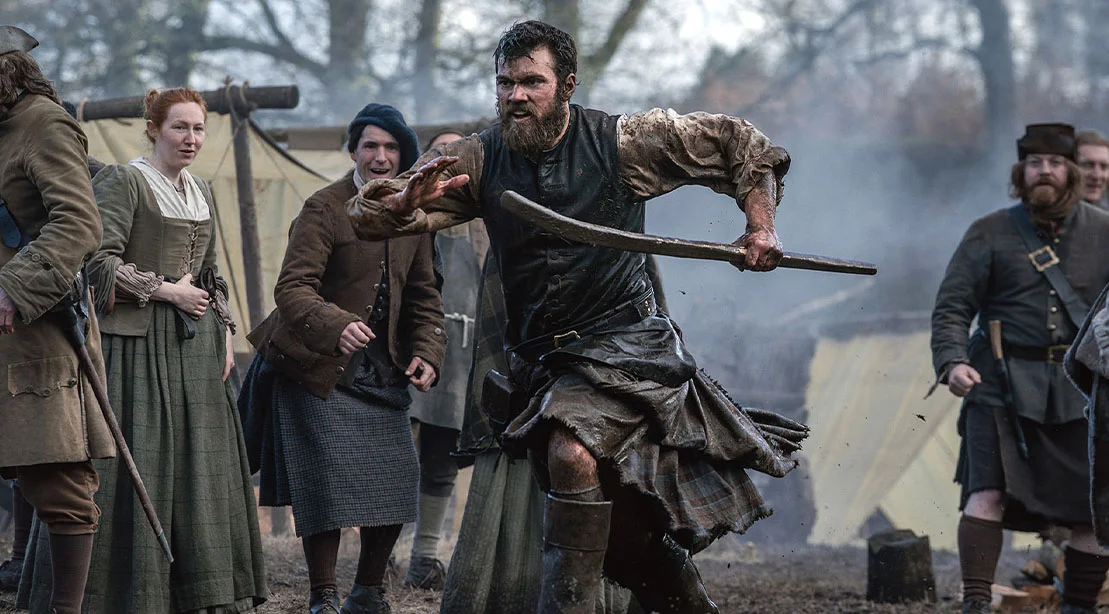
Sam Retford’s preparation for Dougal MacKenzie was built around what the character would need to do: hike for hours, carry weight and stay nimble in a fight. For Outlander: Blood of My Blood, the Glasgow-based actor paired gym work with hill rucking and outdoor practice, aiming for a body shaped by the Highlands rather than by a mirror. That distinction matters: a physique designed for a close-up can look convincing while standing still, but the role asks for movement across rough ground and through demanding action.
Retford’s appetite for rough terrain predates the series. Born in Australia, he learned to ride from his mother, whom he describes as “a proper ranch cowgirl.” He’s since gone mountain biking in the Himalayas, crossed rivers in Amazonia and cave dived around the United Kingdom. Those experiences don’t automatically make an actor ready for a period drama’s stunts, but they give him a practical familiarity with exertion, exposure and uncertain footing. Playing a Scottish war chieftain gave those interests a direct use.
Training for the Highlands
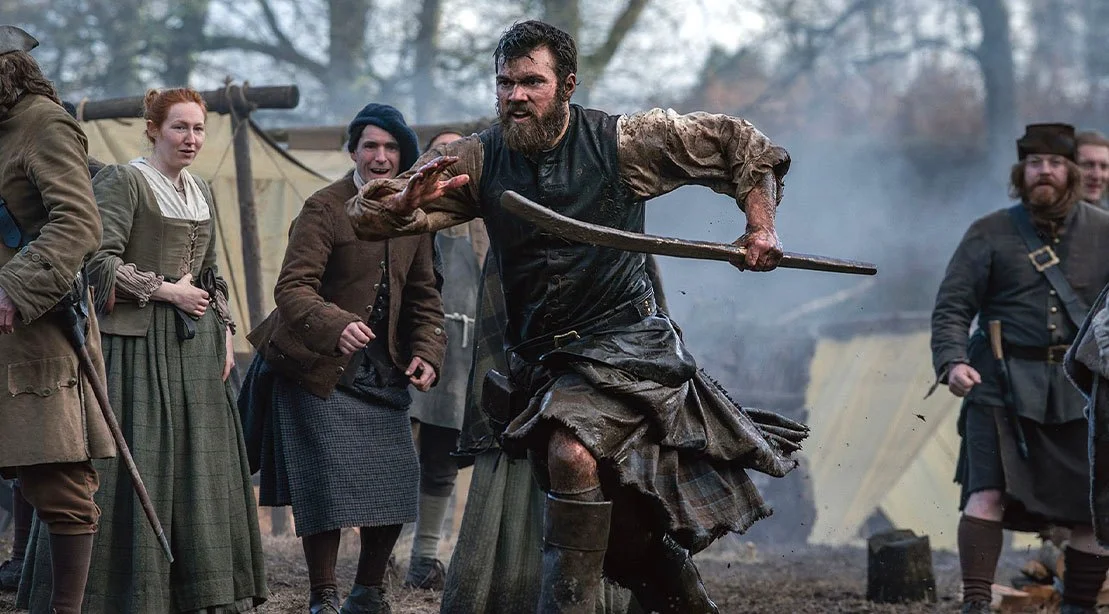
Retford rucked up and down hills with a weighted backpack and even slept outdoors in the heather to get a feel for the conditions. He wanted Dougal to be capable of long winter treks, strong enough to carry heavy loads and agile enough to fight. “Everything had to be functional,” he says. The point wasn’t to imitate a historical training plan; it was to understand how fatigue and terrain might shape the way a person moves.
That goal shaped his idea of the character’s physique. Retford wasn’t chasing a sculpted, camera-ready look; he pictured a powerful back and strong legs, built for practical demands. The distinction is useful for screen action, where strength has to show up in posture, balance and repeated effort, not just in a still image. “Okay, he can lift, but can he swing a sword around as well?”
Strength that transfers to action
Retford’s training history includes a second-degree black belt in Taekwondo, and he pays attention to agility and injury prevention. His gym sessions mix box jumps and other explosive movements with controlled lifting, including squats and overhead presses focused on time under tension and sound form. That combination has a clear purpose: explosive work asks for quick force, while controlled lifts make him pay attention to movement and position. He also uses Indian mace bells to work on balance.
To prepare for uneven ground, he added instability through elevated platforms and single-sided exercises. Those drills can challenge balance and coordination, though no gym setup fully reproduces wet woods or a hillside underfoot. The gap matters when the job calls for sprinting and fighting scenes. For Retford, the most useful practice was running through woods and climbing trees. On set, he kept moving to stay warm.
Season 2 raises the physical demands
The second season pushes Dougal into more demanding action: he fights in Episode 5, is trapped underwater in Episode 6 and gets into a fistfight with Brian Fraser, played by Jamie Roy, in Episode 2. Retford’s comfort holding his breath and his wider outdoor experience fit the work, though the finished scenes depend on a crew of stunt coordinators, effects specialists, lighting and audio teams. A performer’s preparation is one part of the result; timing, camera placement and coordination help make the action legible on screen.
His fighting style also reflects a practical constraint. “You’ll notice I do quite a lot of shield work and headbutting, as opposed to sword fighting,” he says. Retford is left-handed, and says his right-handed combat isn’t very good, so the sword stays sheathed for much of the action. It’s a candid account of how a character’s movements can be shaped by an actor’s strengths and limitations, with choreography finding ways to make those choices read as part of the role.
What the preparation says about the role
This is more significant than it looks: the training suggests that Dougal’s physicality is meant to register as accumulated work, rather than as a polished image. The distinction can help make action feel grounded, especially when scenes ask a character to move through terrain or keep fighting after exertion. It also sets a realistic limit. A workout can prepare an actor for demands, but it can’t by itself establish what the audience sees; performance and the production’s craft still shape the final effect.
If you’re working in this space, Retford’s approach offers a useful reminder that preparation has to match the task. Strength, balance and stamina serve different purposes, and a routine built around one can leave gaps in another. Here’s the thing: the most convincing preparation may be the work that doesn’t show up as a dramatic transformation at all. It shows in how a performer handles the ground, the prop and the pace of a scene (and this is the part most people overlook).
Retford says physical progress takes time and varies from person to person, a point often lost in social media portrayals of rapid transformation. His account pushes against the idea that a single before-and-after image can explain preparation; the work described here involves repeated practice across different settings. For him, the appeal of the role is the work itself: being outside in the cold, running and swinging swords. He’s open to a third season, while also producing a documentary in Uganda and considering a trip to Mexico. His guiding principle is simple: “The key is to just say yes to crazy things.”
Season 2 of Outlander: Blood of My Blood is available to stream via Starz.
Follow Sam Retford on Instagram.

Discussion
Sign in to join the discussion.