Former NFL tight end Julius Thomas argues that sustainable performance depends on recovery, emotional skills and support through major career transitions.
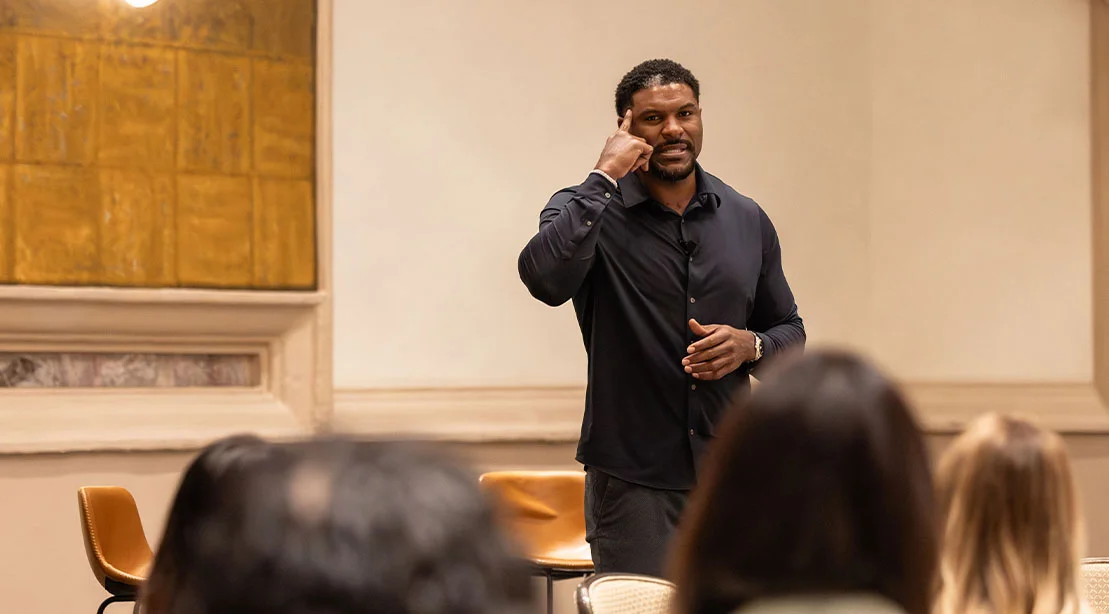
Julius Thomas spent years learning how to perform under pressure in the NFL. His work now points to a less celebrated skill: knowing when to slow down. As a performance coach and consultant, and a clinical psychologist since earning his doctorate in June 2025, Thomas sees emotional regulation and recovery as central to sustained performance.
“One of the things I say is the biggest unaddressed area of performance in all of sport is emotional regulation,” Thomas told Muscle & Fitness. His argument reaches beyond athletes. Executives and other high performers, he says, can focus so intently on output that they overlook the habits and psychological skills that keep them functioning well.
Performance needs recovery built in
The 2026 NFL season has offered a sharp reminder of how vulnerable players are to injury. Six of the 32 quarterbacks initially named starters were hurt early in the season, including Jayden Daniels, Caleb Williams and Jaxson Dart. Philadelphia Eagles quarterback Jalen Hurts is expected to miss the rest of the season after doctors found deep vein thrombosis and bilateral pulmonary emboli. His case was traced to a calf injury caused by an opponent’s cleat.
Thomas doesn’t attribute the run of injuries to one cause, and he doesn’t consider injury unusual in football. “Football has a 100% injury rate,” he said. “Every single person that plays football is going to get injured, so injuries are just high in that sport in general.” Contact is part of the game; training load, playing surfaces, offseason routines, mobility and recovery can all shape non-contact injuries.
Psychological stress may also affect risk. A 2017 meta-analysis in Sports Medicine linked stress responses with higher injury risk and found that psychological interventions reduced injury rates. For Thomas, that evidence reinforces the need to build recovery into the work rather than treat it as an afterthought.
He describes the problem through an engine metaphor: “If you just only floor it, only floor it, only floor it. How long do you think that engine is going to do well?” His answer: “Not very long.” In the body, he connects recovery with the parasympathetic nervous system, which supports rest and digestion and counterbalances the stress response. Without enough sleep and other forms of recovery, he says, the body’s major systems take a cumulative hit.
The same strain shows up in executive life
Thomas sees the same pattern among business leaders. Some have asked him about nootropics to sharpen their focus while describing years of sleeping just four hours a night. His response is a framework he calls “Striving for 100,” organized around five daily habits: exercise, sleep, nutrition, recovery and healthy substance use. Recovery anchors the model.
In one-on-one work, he also draws on evidence-based approaches including cognitive behavioral therapy (CBT) and acceptance and commitment therapy (ACT), using tools such as radical acceptance, cognitive restructuring and reframing. The aim is to help clients address the ways they respond to pressure, not simply add another performance aid to an overloaded routine.
“You’re either gonna pay the cost slowly and surely by recovering in your 30s and 40s and 50s,” Thomas said, “or you’re gonna pay it all of a sudden when you’re sick.” That framing makes recovery a long-term operating practice: small choices can either reduce accumulated strain or allow it to build.
Leaving a career is a performance challenge, too
Thomas knows what it means to rebuild after a high-performing career. He retired from the NFL in 2018 and entered graduate school at age 30 without the routines, clear feedback and daily victories that football had provided. “When you have to go from a master to a rookie, you go from winning a lot, knowing what you’re doing and very comfortable with all of it, to then having to rebuild that,” he recalled. “That is extremely challenging.”
He completed a clinical residency and earned his doctorate in clinical psychology in June 2025, but the transition has taken longer than he expected. A friend had told him the process could take about a decade; Thomas initially rejected that estimate. Eight years in, he says he’s nearly where he wants to be in his next profession.
That experience informs his objection to advice that athletes should simply separate their identity from their sport. Thomas argues that such guidance can understate the difficulty of leaving a career that has shaped daily life and other people’s expectations. Identity, in his view, is built through repeated actions and reinforced by how others see you.
For Thomas, the challenge is still visible in the way people remember him: the two-time Pro Bowl tight end who caught 12 touchdown passes in both 2012 and 2013. “It’s hard to get people to see you in your new career,” he said.
Now he asks athletes preparing for retirement whether they have the psychological tools to find meaning and purpose in what comes next. “Do you have the psychological skills to reframe, recontextualize, find meaning, find purpose?” His message is that difficulty doesn’t mean someone is failing. “Transitions are always hard,” he said, and support can make them easier to navigate over time.
Emotional strain has physical consequences
Thomas’s clinical work and studies in psychoneuroimmunology have shaped how he thinks about emotion and physical health. “Emotions trigger our nervous system,” he said. Learning to manage emotions and reduce negative ones, he argues, can lessen sustained stress on the nervous system.
He describes the effects as interconnected: chronic stress can disrupt sleep and diet, while persistent anxiety can increase muscle tension. The experience may be difficult to see on an X-ray, but it can still affect daily functioning.
There’s evidence that naming a feeling can help. A 2007 UCLA brain imaging study in Psychological Science found that labeling emotions dampened the amygdala’s response to negative images. Thomas sees emotional awareness as a practical skill, especially for people who weren’t taught how to identify what they feel or work through prolonged stress.
Access and willingness remain obstacles. Thomas cited CDC data showing that 10.9% of U.S. men receive counseling or therapy from a mental health professional, compared with 16.9% of women. He’s also struck by how readily people seek help for physical discomfort while handling emotional pain alone. As a player, he said, he had no hesitation about visiting the training room for a sore ankle.
“We are constantly asking for help in so many areas of our life,” Thomas said, “but we somehow, as a culture, believe that we should handle what’s in our heart and in our mind by ourselves.” His point is simple: psychological care belongs in the same conversation as the habits people already use to stay healthy and perform.
Sharing the work at Eudēmonia
Thomas is scheduled to appear at Eudēmonia on November 5–8, joining speakers from across health, wellness and longevity. He says relationships formed at the event—with people working in psychology, neuroscience, medicine and mind-body practices—continued to influence him long after his first visit.
He’ll return for keynotes on mental health and a panel on mindset, performance and adaptation. He wants attendees to leave with hope, practical steps and knowledge they can apply to their health and daily functioning.
For Thomas, the larger point applies whether someone is preparing for a new career or trying to sustain demanding work: recovery and well-being have to be part of the routine. “If you want sustainable high performance, you have to build well-being and quality of life into what you do.”

Discussion
Sign in to join the discussion.