Adjustable dumbbells can cover a wide range of home workouts in a small footprint. Weight range, increments and expansion options determine how well they fit.
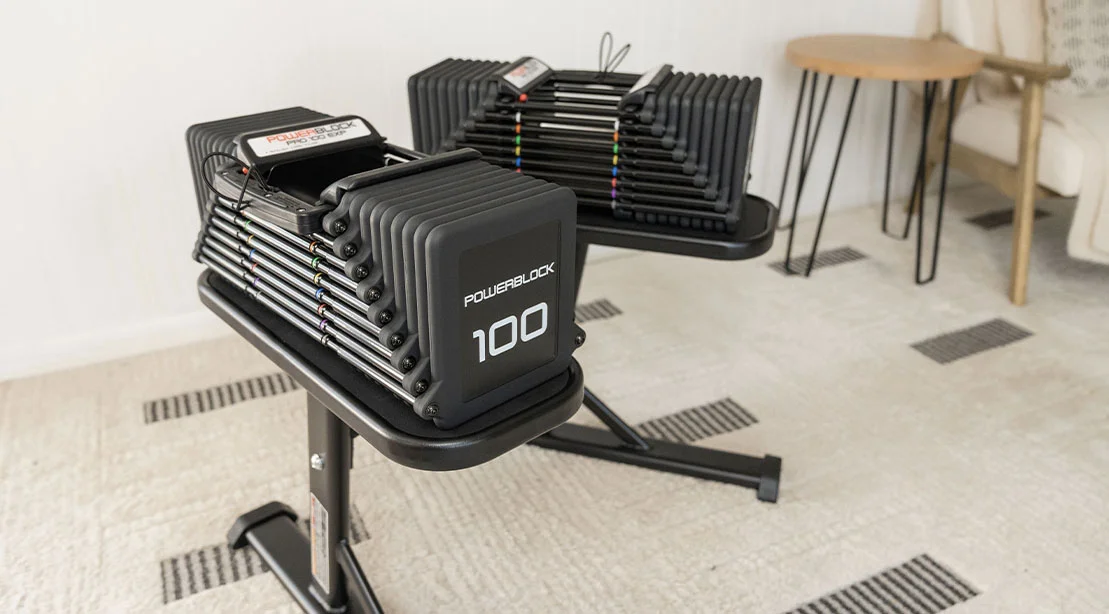
For a home strength routine, the main equipment decision is often how to get enough weight options without giving up too much space. Adjustable dumbbells answer that constraint with a single set that can support presses, rows, curls, lunges and other familiar movements. They can also simplify the choice between buying a few fixed pairs now and adding more as training needs change. Research has linked strength training to better health and physical function, while a home setup can make regular sessions easier to fit into a schedule. The equipment can remove one practical barrier, though it can’t supply the habit or the plan.
The trade-off is that adjustable models vary in feel and operation. Handle shape, grip, adjustment mechanism and available resistance range all affect how a set works in practice. A model that suits pressing may not offer the lighter increments someone wants for shoulder raises, so the range and loading steps deserve as much attention as the maximum weight. Changing loads can also interrupt a workout if the mechanism feels awkward or takes longer than expected. That’s a small inconvenience on paper, but repeated friction can matter when a routine depends on fitting exercise into a short window.
Build the routine before expanding the kit
Starting with a clear training goal helps narrow the equipment choice. For a basic full-body plan, presses, rows, squats, lunges and curls provide a practical foundation because they cover several common movement patterns with relatively little equipment. Learn the movements and use a load that challenges you while allowing controlled technique; one weight may not suit every exercise. A press and a curl can call for different resistance, and smaller muscle groups may benefit from more gradual increases. The point is to match the set to the work you expect to do, rather than treating its heaviest setting as the main measure of value.
Space still matters, even with a compact set. Measure the area where you’ll lift and store the dumbbells, and leave enough room to move through each exercise safely. Check where the set will sit between workouts, too: a piece of equipment that has no convenient storage spot can become a daily obstacle. As strength improves, record weights and repetitions and raise resistance gradually. Consistency and sound technique give a routine room to progress. A simple log can also show when a current load has stopped being challenging, making it easier to decide whether a higher range is useful.
Two PowerBlock options, different ceilings
Adjustable dumbbells have been sold for decades, with manufacturers using different mechanisms to make load changes quicker. PowerBlock, founded by Carl Towley in Owatonna, Minnesota, in 1993, uses a nested weight stack and magnetic selector pin. Its compact format combines several resistance settings in one set. That design is a distinct approach to the same basic problem: storing a useful range of weights without dedicating room to a rack of separate pairs. Buyers should still consider how the shape and selector system feel in hand, since compact storage doesn’t automatically mean every exercise feels familiar.
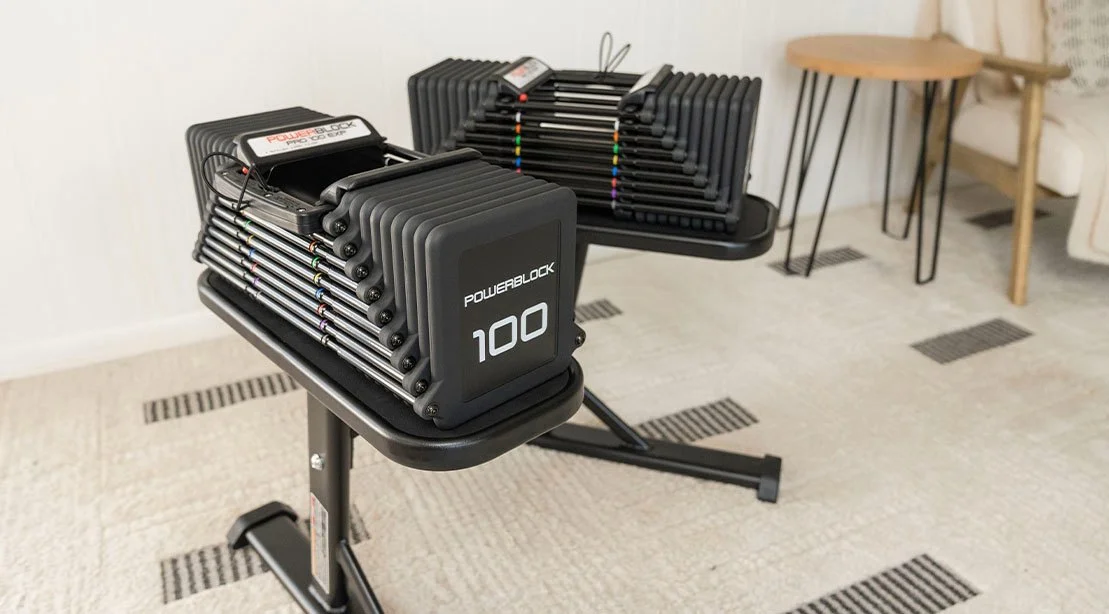
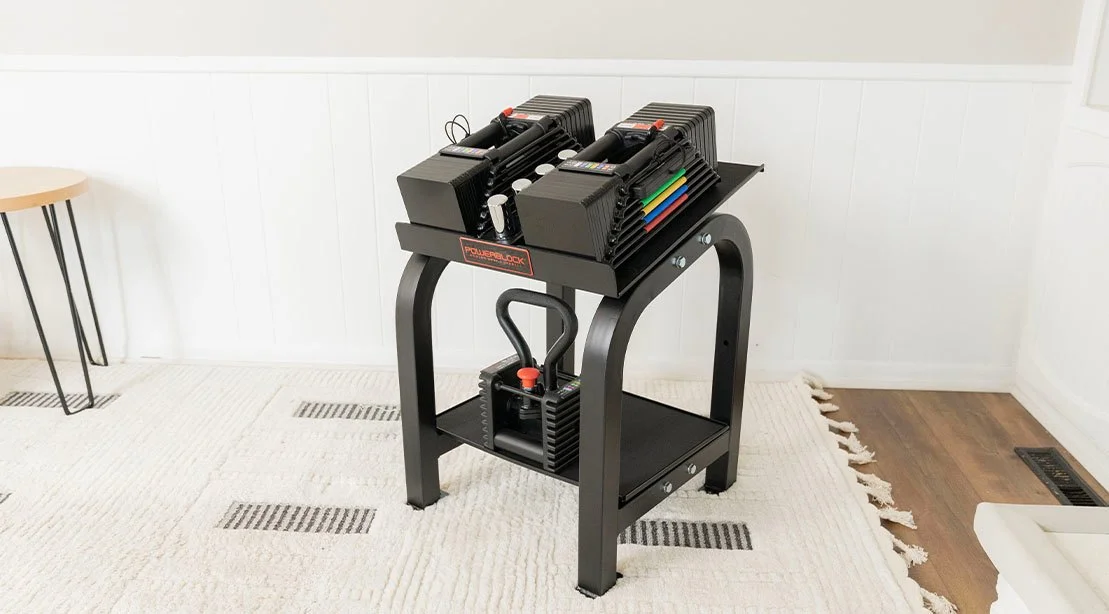
The company sells both fixed-range and expandable models. Expandable sets can be upgraded with model-specific kits, letting buyers add capacity over time. That flexibility can make a lower starting range more practical, but it also means the full capacity depends on buying compatible additions. The Pro 100 EXP starts at 5 pounds per dumbbell and can reach 100 pounds with additional kits. Depending on configuration, increments run from about 2.5 to 5 pounds. Urethane-coated plates and grip options are among its features, and PowerBlock says the set replaces 30 pairs of traditional dumbbells. That replacement claim describes the range the set is intended to cover; the actual usefulness depends on whether its increments match an individual’s program.
The Elite USA 90 tops out at 90 pounds per dumbbell. It uses steel plates made in the United States and offers 2.5- to 5-pound increments. PowerBlock says it replaces 28 individual dumbbells and 825 pounds of free weights in a compact footprint. Those figures help convey the storage argument, but maximum range and stated replacement capacity shouldn’t settle the choice by themselves. If your training uses lighter loads or a narrower selection, extra capacity may not earn its keep; if you expect to lift heavier over time, the ceiling matters more. The numbers here are underwhelming as a way to judge comfort or ease of adjustment.
Josh Leake of PowerBlock describes the company’s focus as serving people at different stages of training. “Our focus is to provide high-quality, versatile fitness equipment for people at every stage of their fitness journey, whether they’re just getting started or continuing to pursue their goals,” he says. “Looking to the future, our goals are to keep providing premium home fitness equipment and continue to innovate to serve our customers best.” The statement sets out the company’s aim, while the product details offer more concrete points for comparison: capacity, increments, materials and expansion options. For shoppers, the practical question is whether those features fit the routine they’ll actually follow.
What to compare before buying
An adjustable set makes the most sense when a full rack would be impractical or when several resistance options need to fit in a small area. Before choosing one, compare the weight range, increments, adjustment process, dimensions, expansion kits and price. Consider the loads your regular exercises require and whether the set can accommodate future progress. Also think about how often you’ll change weights during a session and whether the handling suits the exercises you plan to do. If you’re working in this space, the distinction between advertised capacity and day-to-day usability is the detail customers may overlook.
Here’s the thing: a compact set only saves space if its design works for the person using it. A larger maximum can be useful, but it won’t compensate for increments that don’t suit the routine or an adjustment method that feels cumbersome. (And this is the part most people overlook.) The most useful comparison is between the set’s actual loading steps and the exercises you expect to perform.
What the choice means for a home routine
Adjustable dumbbells make a home setup easier to scale without adding a separate pair for every load. That’s a meaningful convenience for people with limited room, and expandable models offer a way to add capacity as training develops. Yet the equipment is only one part of the decision: exercise selection, safe technique and regular use determine whether the range gets put to work. A set that stays accessible and fits your schedule can support consistency. Just a tool, with real limits.
A useful home gym can start with one well-matched piece of equipment. What this means for you is straightforward: choose for the space you have, the movements you’ll do and the resistance steps you need now, while checking whether the set can grow with you. The best choice is the set that fits the available space and supports a routine you’ll keep doing.


Discussion
Sign in to join the discussion.